SIM (Subscriber Identity Module)
SMS (Short Message Service)
MMS (Multimedia Message Service)
E-mail (Electronic mail)
Voicemail
Video Conferencing
Chat
Wi-Fi
- Internet Connection
- Wireless Router
- Computers having a wireless network card.
Wi-Fi Hotspot
WiMax
VOIP
1G mobile system
2G mobile system
2.5G mobile system
3G mobile system
4G mobile system
WLL
GPRS
You can also watch this video
Wireless Communication
Mobile Communication
Mobile Communication Technologies
Network Protocol / Communication Protocol
HTTP
FTP (File Transfer Protocol)
TCP/IP (Transmission Control Protocol / Internet Protocol)
- TCP: It breaks the data into packets that the network can handle efficiently. It manages the assembling of a message or file into smaller packets that are transmitted over the internet. It verifies all the packets when they arrived at the destination computer and then reassembles them in proper order. Data can be lost in the intermediate network, so TCP adds supports to detect errors or lost data and to Trigger transmission until the data is correctly and completely received.
- IP: The internet protocol (IP) handles the address part of each packet so that it reaches the right destination. It gives a distinct address (called an IP address) to each data packet. It checks this address to see where to forward the message and finally they reassembled at the destination.
PPP (Point to Point Protocol)
PPP is a communication protocol used to establish a direct connection between nodes. It connects nodes without using any device or any host. It is used over phone lines and any other physical cable. It basically designed to help communication between two systems through telephone lines.
Telnet
Telnet is the main protocol for creating a connection with a remote machine. It allows us to connect with a remote computer over a TCP/IP network or internet. Once our Telnet client establishes a connection to the remote host our clients become a virtual terminal, allowing us to communicate with the remote host from our computer with whatever privileges you have been granted to the applications and data on the host computer.
SMTP (Simple Mail Transfer Protocol)
SMTP is a set of communication protocols that allow the software to transmit an e-mail over the internet. It is a program used for sending emails to other users based on e-mail addresses.
Types of Computer Network
- Personal area network (PAN)
- Local area network (LAN)
- Metropolitan area network (MAN)
- Wide area network (WAN)
Personal area network (PAN)
Local area network (LAN)
Metropolitan area network (MAN)
Wide area network (WAN)
Network Devices
Modem (Modulator-Demodulator)
HUB
- Active Hub: Active hubs Electrically amplify the signal as it moves from one connected device to another.
- Passive Hub: Passive hub allow the signals to pass from one computer to another without any change.
Switch
Gateway
Ethernet Card
Ethernet is a LAN architecture developed by Xerox Corporation. Ethernet uses a Bus or star topology and can support Data transfer rates of up to 10 Mbps. In computer for use of ethernet have to install a special type of card called Ethernet card.
Ethernet card is a kind of network adaptor and is also known as a network interface card (NIC). It supports high-speed network connections via cables. Newer internet cards are installed usually by the manufacturer inside the computers.
RJ-45 Connector
Bridge
Router
Repeater
Wi-Fi Card
Advantages of Microwave
- It offers ease of communication over difficult terrain.
- Microwaves have the ability to communicate over oceans.
Disadvantages of Microwave
- It is an insecure communication.
- Its propagation is susceptible to weather effects like rains, thunderstorms, etc.
- Implementation and maintenance cost is high.
- Bandwidth is limited.
Advantages of Radio Wave
- It is easy to communicate through radio waves in difficult terrains since there is no need for any type of cable.
- It can travel long distances in all directions. Also they can easily pass through obstacles like buildings so it can be used anywhere.
Disadvantages of Radio Wave
- Data Transmission is not secure.
- The radio wave is susceptible to weather effects like rains, thunderstorms, etc.
Advantages of Infrared
- It having short-range communication hence it is a secure mode of transmission.
- It is quite an inexpensive transmission medium.
Disadvantages of Infrared
- It can be only used in short-range transmission.
- Infrared wave transmission cannot pass through obstruction like walls, buildings, etc.
Optical Fiber
- Core - The glass or plastic through which the light travels.
- Cladding - Cover of the core that reflects light back to the core.
- Coating - It protects the fiber cable from a hostile environment.
Types of Optical Fiber Cable
- Single-node: It supports a segment length of up to 2 km and bandwidth of up to 100 Mbps.
- Multi-node: It supports a segment length of up to 100 km and bandwidth of up to 2 Gbps.
Advantages of Optical Fiber
- It is immune to electrical and magnetic Interface.
- It is guaranteed secure transmission and has a very high transmission capacity.
- It can be used for broadband.
Disadvantages of Optical Fiber
- It is difficult to install and maintain since they are quite fragile.
- It is most expensive in all the cables.
- Connecting two fiber cable together is a difficult process.
Types of Twisted Pair Cable
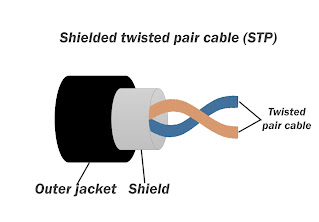
- Shielded Twisted pair cable (STP)
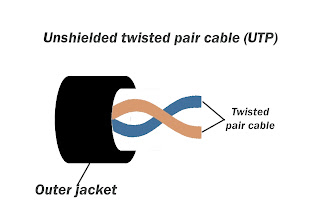
- Unshielded Twisted pair cable (UTP)
![]() |
| Shielded Twisted Pair (STP) Cable |
![]() |
| Unshielded Twisted Pair (UTP) Cable |
Advantages of Twisted Pair Cable
- It is simple.
- It is physically flexible.
- It is easy to install and maintain.
- It can be easily Connected and has a low weight.
- It is very inexpensive.
Disadvantages of Twisted Pair Cable
- It can be easily pick up noise signals.
- Being thin in size, it is likely to break easily.
- It is unsuitable for broadband applications.
Data Channel
Baud
Bandwidth
Data Transfer Rates
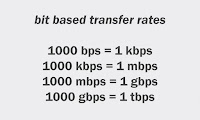
Bit based transfer rates
Byte based transfer rates
Node, Server, and NIC
![]() |
| Server |
- Dedicated Server
- Non-Dedicated Server
Network Interface Unit (NIU)
- Circuit Switching
- Message Switching
- Packet Switching
1) Circuit Switching
2) Message Switching
3) Packet Switching
Networking Basics syllabus for 12th class (Science and Commerce) - JAC, CBSE, and State Boards
Evolution of Networking: ARPANET, Internet, Interspace, switching techniques
(Circuit, Message, and Packet switching), NIC.
Data Communication terminologies: Concept of Channel, Bandwidth (Hz,
KHz, and MHz) and Data transfer rate (bps, Kbps, Mbps, Gbps, Tbps), Baud.
Transmission media: Guided, Unguided, Twisted pair cable, coaxial cable,
optical fiber, infrared, radio link, microwave link, and satellite link.
Network devices: Modem, Hub, RJ45 connector, Ethernet Card, Router, Switch,
Gateway, Repeater, Wi-Fi card.
Network Topologies and types: Point to Point Link, Bus, Star, Tree, Mesh,
Ring, Graph, PAN, LAN, WAN, MAN.
Network Protocol: HTTP, TCP/IP, File Transfer Protocol (FTP), PPP, SMTP,
Remote Login (Telnet), and Internet Wireless/Mobile Communication protocol such
as GSM, CDMA, GPRS, and WLL.
Mobile Telecommunication Technologies: 1G, 2G, 3G and 4G, VOIP, WiFi, and WiMax;
SIM, SMS, MMS, E-mail, Voicemail, Video conferencing, Chat.
Network Security Concepts: Viruses, Antiviruses, Spams, Use of Cookies,
Protection using Firewall, https;
India IT Act, Cyber Law, Cyber Crimes, IPR issues, hacking.
Introduction to Web services: WWW, HTML, XML;
Domain Names, URL, Website, Web browser, Web Servers, Web Hosting;
Evolution of networking
ARPANET
Internet
Interspace
Introduction of Computer Network.
Network Goals and Applications
- Resource Sharing: The hardware devices like printers and scanners can be shared over a Network. This reduces costs by reducing the number of hardware items.
- Storage Sharing: On a network, the user can access the data of another machine and can store data on another machine.
- Reliability: A file can have copies on two or three different computers. So, if one is not available other copies can be used.
- Access to a remote database: User can access the Host computer at his PC and send the request. For example - users can make flight reservations, book hotels, and so on anywhere in the world with instant confirmation.
- Communication Facilities: Network provides us facilities to communicate with others via Emails, Chats, Video conferencing, and so on.
Disadvantages of Networking
- Complex: Systems are more complex to run.
- Server fails: If all data are held centrally in a server. It may create problems if the central server fails.
- Expensive to install: Cables, Network devices, NIC, and Softwares required for installation of the network. And these are quite expensive.